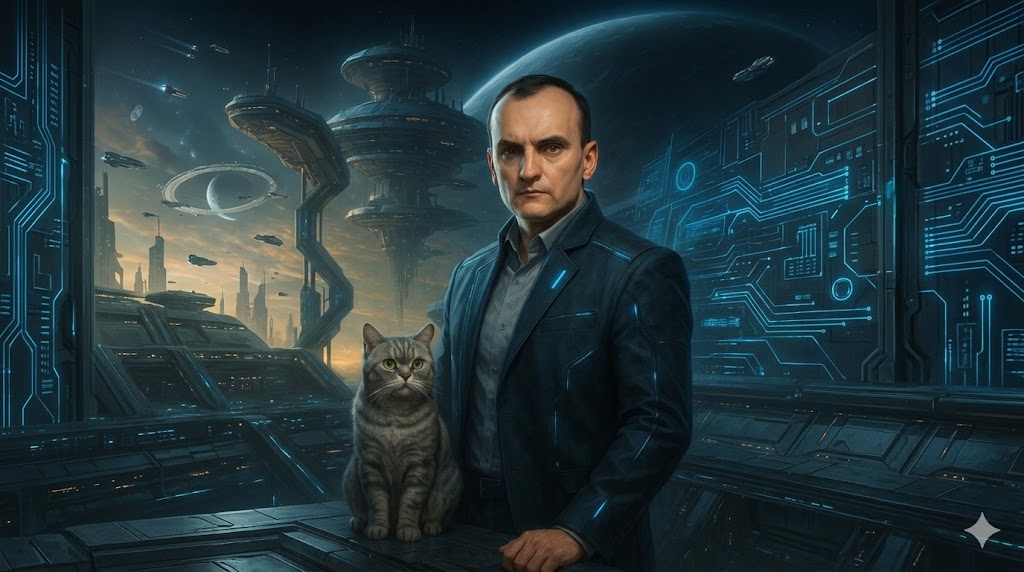
In a world where roles like artist, designer, programmer, architect, and executive once existed separately, they are now converging into a single role — the creator. This person doesn’t just execute tasks; they shape systems, define logic, design interfaces, and create meaning. This isn’t evolution — it’s compression of responsibilities into a single point of control.
A modern digital product is no longer built as “one team per task.” It is created as an integrated system where every component influences the others. At the core of this system are three pillars — Programming, Design, and 3D Modeling.
Programming is the foundation. It defines structure, enforces rules, and ensures reliability. Without it, there is no logic, no processes, and no system. It is the skeleton of the product — and it must be clean, scalable, and resilient.
Design is not about aesthetics — it’s about clarity and efficiency. It transforms complexity into usability. Great design reduces errors, speeds up decision-making, and directly impacts business outcomes.
3D modeling represents the next level of perception. It adds depth, visual hierarchy, and emotional engagement. Where flat interfaces fall short, immersive visualization enhances understanding — especially in analytics, dashboards, and complex systems.
The combination of these three domains enables a single individual to build full-scale ERP-level products. Not prototypes — but real systems that automate business processes, manage finances, and deliver actionable analytics.
Previously, such systems required large teams and months of coordination. Today, speed is defined not by headcount, but by depth of skill. A single creator with strong capabilities across all three pillars can outperform a large but fragmented team.
For product teams and investors, this shifts the entire game. Development costs drop, time-to-market shrinks, and product control improves. The primary risk moves from “building a team” to “finding a systems thinker.”
Such products already exist. They unify accounting, finance, projects, and analytics into a single interface. Their value lies not only in functionality, but in usability — a direct result of synergy between the three pillars, not compromise.
The three pillars are no longer a theory or metaphor. They are a practical model for building next-generation digital products. Mastering them is not just a skill — it’s leverage to shape the future of business systems.
The three pillars are not a one-time skill set — they are a continuous improvement process, which is where kaizen comes into play. Code becomes cleaner, design clearer, and visualization deeper with each iteration. Small, consistent improvements lead to systemic product quality without sudden cost spikes. For businesses, this means predictability; for investors, stability; for products, longevity. In the end, the winner is not the fastest — but the one who improves continuously.
The "Creator" concept unifies programming, design, and 3D modeling into a single workflow, empowering a single expert to build high-efficiency ERP systems. By applying Kaizen principles to this synergy, one can achieve continuous product improvement and gain a significant advantage in speed and quality over traditional development teams.
The 3D Scorpion logo symbolizes the synergy of global IT solutions, engineering precision, and the creator's personal accountability for system quality. The visual composition blends robust architecture with the Kaizen philosophy, highlighting a commitment to continuous improvement and the uncompromising protection of client interests.
MyErp is a high-tech ecosystem that combines rigorous Domain-Driven Design architecture with SaaS flexibility to streamline enterprise resource planning. The platform transforms fragmented data into a unified decision-making environment, prioritizing security, scalability, and continuous evolution through Kaizen principles.